
Championing the History of the Humble Broom
When the thought popped into my head that I’d never heard the history of brooms I opened my phone and did a quick search, two or three websites all said the same thing, almost verbatim, “In 1797 a farmer from Hadley Massachutus made a broom from sorghum and she liked it so well she shared it with her friends and the modern broom was born. Then around 1810 the Shakers modified the attachment of the fibers and created the flat broom” Usually there is also a note that in Europe brooms were made from birch or besoms and were made in southern areas by besom-squires.
As my interest was in medieval brooms I tried digging deeper, but every search lead me back to the same pat “history” excluding the spans of time prior to 1797.
Brooms have in all likelihood existed with the earliest of human tools, and their basic function has in fact not changed much- to sweep away dirt and debris, but despite their seemingly basic function I still found their history interesting! With few trails leading me to more in-depth facts about brooms in period. I started going down every rabbit trail I could find. I will do my best to present what I have learned about the sweeping history of the humble broom and its lasting impact here.
Materials and Methods:
The meaning of the word broom itself is twofold, the cleaning implements we are discussing here, and the type of plants often used to make those implements:
Broom: noun,ˈbrüm ˈbru̇m
1: any of various leguminous shrubs (especially genera Cytisus and Genista) with long slender branches, small leaves, and usually showy yellow flowers
especially: SCOTCH BROOM
2: a bundle of firm stiff twigs or fibers bound together on a long handle, especially for sweeping
As can be expected homemade brooms varied by region, their heads, binding fibers, and sticks made from whatever local plants and trees were most accessible and well-suited to the task. However, Some regions were more plentiful in specific plants and broom-making industries naturally took root.
The most common types of brooms with the largest industry/impact seem to have been Besom Brooms and Heather Brooms. The word “besom” is derived from the Old English word “besma,” meaning a bundle of twigs or bristles, commonly the twigs were coppiced birch.
From existing images of brooms in portraits, paintings, etchings, and illuminations there seem to have been three main styles of construction:
1. Long Handeled Brooms with a bound head
Ex: Book of hours, MS M.32 fol. 85, France, ca. 1470

2. Long Bundle Brooms where the bristles and handle are all one bundle bound in multiple places
Ex:Le mortifiement de vaine plaisance, France, Angers, between 1455 and 1460, MS M.705 fol. 50r

3. Small hand brooms which seem to have wooden or woven tops
Ex: The Holy Family, Joos von Cleve 1512-1513, Netherlands

General Broom-Making Process
Unfortunately with the lack of written and pictorial evidence, I was forced to rely on out-of-period resources for the actual construction techniques as you’ll see in the Period Production images below. With this in mind, I looked for the oldest sources I could, even in these sources things were described as being done the traditional way so I believe that this is likely close to how they would’ve been made in period. In my searching I was pointed to a wonderful blog, Hom Craefts by Rosario Depew who documents the process of broom building so well that I see no need to replicate it myself as my interest lies more in the history than construction and will instead include her description of construction here:
England
Jenkins (1978: pp. 88-89).
- Collecting material for the head:
- The material is selected from the crown of the birch tree and left to season for several months until the twigs are hard but pliant – if used too soon, the finished besom will be too brittle. 3-5 year old coppiced birch is best.
- Making the handle:
- After the rods for the handles have seasoned, they are placed in a shave horse and the bark is removed with a drawknife. They are then smoothed with a draw shave, and the ends pointed with an axe.
- Selecting material for the head:
- The piles of seasoning material are opened up, trimmed with a short-bladed billhook and then sorted by hand. The pieces that are too small and brittle for besoms are cut away and the rejected material is later tied into bundles and sold as firewood. The brush is then sorted into two groups: a) the longer, rougher material for the core; b) the smoother, shorter strands for the outside of the head.
- Making the head:
- A handful of longer, rougher birch twigs are rolled together, and then a bundle of shorter, smoother twigs is arranged around them. When satisfied, the head is tied with two bonds of either willow or wire. The butts of each head are then chopped away using a chopping block and short-handled axe.
- Fitting the handles (‘tails’):
- The handle is inserted into the base and driven squarely home into the head. The head is then secured between the two bonds either with a nail, or by boring a hole in the handle with a small spiral auger and inserting a wooden peg.
Per Traditional British Crafts:
- The Broom Handle
- The broom handle can be made using ash, lime, or hazel.
- The handle could be sharpened on one end with a hand axe that would be driven into the broom head bundle.
- The Head of the Broom
- Cuttings from the crown of a seven-year-old birch trees were stacked in bundles in autumn, to weather and season over winter.
- In spring the twigs were trimmed with a billhook, and sorted the twigs, cutting away brittle material with a stripping billhook.
- The long, rough twigs were separated out for the core of the besom, while the shorter, smoother twigs would be reserved for the outside layer.
- The besom/broom was bound by hazel or willow.
Period Production
Bürstenbinder, Jost Amman, 1568, Germany


Bezembinder, Jan Georg van Vliet, 1635, Netherlands
De Bezembinder, Jan Luyken,1694, Netherlands

These three images show broom makes in an established workshop. Two from the Netherlands and the other from Germany. In them, we can see some of the tools used: a pitchfork, scissors, cleaver, bench, binding fiber, boxes, and pots.
In ‘Bürstenbinder’ a hand broom is being made, wrapped with a ball of some type of fiber with several other bundles laid out ready for bulk assembly. The brooms are hanging in the window which I believe would have faced the street acting as a shopfront as supported in ‘De Bezembinder’ and also this etching of ‘Borstelmaker’, also by Jan Luyken in 1694 both in the Netherlands.

We don’t see any additional tools in ‘De Bezembinder’, however we do see a different way of creating the necessary tension for binding the brooms than depicted in ‘Bezembinder’ as well as we see a woman helping gather the bundles for binding.
In ‘Bezembinder’ and ‘De Bezembinder’ they are making broom heads which will be fixed with a handle. (Unfortunately, no handle is shown. In the same Book of Trades by Jan Luyken there is a depiction of a Pole-Maker and I wonder if they bought the poles instead of making them in-house.)
Broom Making as a Profession and in Society
The above depictions of Broom Makers in their stalls as established makers are a contrast to the descriptions of Besom-Squires which I saw mentioned most frequently when beginning this research. While we read Besom-Squire and think of an honorable profession in reality they were viewed closer to Romani peddlers.
Further explanation of the history of the term Broom-Squire explained that “Broom-squires were necessarily restricted to the heathlands of England, such as the Surrey Heaths of the story and the New Forest further south, though at times the brush of the broom wasn’t heather but birch twigs, strictly speaking turning their makers into besom-squires, a term that appears only rarely… Broom-squires, often itinerant and always poor, had an unsavory reputation not so far removed from the then conventional view of gypsies.”
In fact, Broom-Making was also something done by Romani as well, while out of period, inthe “History of the Gypsies,” William Simson tells us that “a few of the colony employ themselves occasionally in making besoms, peat basses, etc., from heath, broom and bent, and sell them at Kelso and neighboring towns.”

While the term Broom-Squire appears more often another term also appears to describe a dealer in brooms: Broom-Dasher. While it is uncertain if these individuals were more respected or also considered an unsavory lot the word does seem to express more of a retail business than the wandering peddler. We also see the title Broom-Dasher in the poem by Raimon d’Avinhon: A Busy Man,
A man gets busy
and the world is wide
a servant I was and more besides…
a molecatcher a ratkiller a glover
a broomdasher a lover
I made corsets dug graves
built boats rode the waves
Broom Peddling appears to have been the occupation of both women and men although it’s possible that women peddlers became more common post-period. The below etching dated 1765 shows a female peddler and a popular song from the late 1700s -The Besom Maker tells the story of a young broom peddler who will sell all of her brooms wholesale as she has become a mother.
Anne Claude Philippe de Tubières, comte de Caylus, 1765 Paris

In fact, brooms have a musical history as well in that broom peddlers often sang songs encouraging passersby to buy their wares. In John Bael’s Play The Three Laws (1548):
Infidelity enters singing a silly song:
Brom, brom, brom, brom, brom [broom]
Bye brom, bye, bye.
Bromes for shoes and powchernges [rings for closing a purse],
Botes and buskyns [half boots] for new bromes.
Brom, brom, brom.
In Tudor Musical Theater: Staging Religious Difference from Wisdom to The Winter’s Tale by Katherine Steele Brokaw she notes, “Infidelity is musically advertising his brooms, he presents himself as a street peddler. The “Brom” song title is printed in the Stationer‘s Register of 1563–4; broom-selling songs were a particularly popular type of street cry”
Le marchand de balais Cris de Paris, ca 1500, BnF, Arsenal, Est. 264 Res. pl. 21

We also find a reference to buying brooms from merchants in The Good Wife’s Guide (Le Ménagier de Paris): A Medieval Household Book, “Primo, a clerk or valet is needed to purchase greenery, violets, garlands, milk, cheese, eggs, firewood, coal, salt, vats, and washing tubs both for the dining hall and for the pantries, verjuice, vinegar, sorrel, sage, parsley, fresh garlic, 2 brooms, a shovel, and such like.“
In the Probate Inventories of the York Diocese, 1350–1500 we find two besoms listed under Couper, Geoffrey, and Idonea, York,1402 [YML, Probate Jurisdiction, Inventories, L1(17)24] as kitchen assets, “5s. Two wort leads in the oven 8s. A vat with a lid of boards 6d. Other haberdashery namely besoms, lockers, old hatchets, axes, mills, and percers 4d. TOTAL £2 7s. 1d.”
Brooms and Gender
Witches and Broomsticks:
When discussing the topic of brooms and gender I would be remiss to not at least mention the long association of witches with brooms and broomsticks.
‘Le Champion des Dames’ (1451)

Interestingly enough it was a man, Guillaume Edelin, who first confessed to flying on a broom in 1453.
The association with women witches was first documented in the illustrations of the 1451 edition of French poet Martin Le Franc’s Le Champion des Dames (The Defender of Ladies).
Additional accounts can be found over a span of years such as the following:
“In Ireland, in 1324, a wealthy widow named Alice Kyteler was accused of witchcraft. One of the many accusations against her was that she had been spotted sweeping her neighbors’ doorsteps in an attempt to sweep their good fortune away from their houses and into her own.”
“Antoine Rose, who in 1477, when accused of witchcraft in France, confessed that the Devil gave her flying potions. She would “smear the ointment on the stick, put it between her legs and say ‘Go, in the name of the Devil, go!”
In the 1400s Jordanes de Bergamo wrote “The vulgar believe, and the witches confess, that on certain days or nights they anoint a staff and ride on it to the appointed place or anoint themselves under the arms and in other hairy places.” at least two other “confessions” state that they had been on a journey.
Unfortunately, women literally flying on a broomstick is a less likely scenario than having an out-of-body experience as a result of “Flying Ointment” (hallucinogens) being applied to mucous membranes, such as on the genitalia via an accessible household object
Housewife Instructions
While images from the period do depict men using brooms as well, the majority of brooms in use and in household settings are by women. The Oxford Handbook of Women and Gender in Medieval Europe includes an instruction which was given for housewives to, “rise early and pray, immediately thereafter turn your attention to the housework: wake up the servants, light the fire, sweep, start breakfast, dress the children, make the beds, do the laundry, take care of the chickens, etc.
A similar instruction can be found in The Book of Husbandry, by Anthony Fitzherbert, “What warkes a wyfe shulde do in generall. First, at rising, bless thyself. … And whan thou arte Sweep the house,vp and redy, than first swepe thy house, dresse vp thy 8dyssheborde, and sette all thynges in good order within milk the cows, dress the children.thy house. “
In Le Ménagier de Paris a French medieval guidebook from 1393 there is a strange story given to implore wives to be submissive to their husbands, In this tale there is a competition between three husbands and three abbots as to who is more submissive, their wives or their monks. They instruct the wives to go to sleep with a broom in the bedroom corner and the monks to leave their door open and place a switch under their pillow to wait for punishment. The monks all do as they are told but the wives all reacted strongly and refused causing the husbands to lose the bet.

The Bern Riddles
In this riddle/poem the broom is Anthropomorphized as a young woman.
The Broom Poem,“de scopa,” Riddle18
Florigeras gero comas, dum maneo silvis,
Et honesto vivo modo, dum habito campis.
Turpius me nulla domi vernacula servit
Et redacta vili solo depono capillos:
Cuncti per horrendam me terrae pulverem iactant,
Sed amoena domus sine me nulla videtur.
Translated:
I have flower-blossoming hair as long as I am in the wood
and I live in a worthy way as long as my home are the fields.
In a more terrible way than me no maidservant serves in the house
and put to work on the vile floor I drop my hair.
Everyone drags me through the horrible dust on the floor
but no lovely home can exist, it seems, without me.
Answer: A Broom
A Missing Link
Something that continues to frustrate me is the insistence of the recurring broom ‘history” that the Shakers first invented the flat broom. In several medieval paintings, there are what seem to be very clearly flat hand brooms. (There could be an argument to be made that these items should be labeled as brushes, but for the sake of this project I will call them hand brooms.) These brooms also do not seem to be the wild and twisted broom heads of birch or heather but seem to be something closer to the sorghum or broomcorn of American brooms.
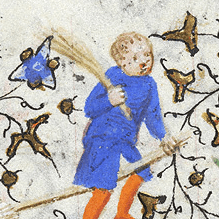


1.Book of Hours, MS M.1004 fol. 96r, France, Paris, ca. 1420-1425.
2.Saint Matthew the Evangelist, Gabriel Malesskircher, 1478, Museo Nacional Thyssen-Bornemisza, Madrid, Inv. No. 234 (1928.16)
3.Folio 29v – Tuebingen House Book, 15th Century
4.A Dutch Interior, Quiringh Gerritsz Van Brekelenkam, 1640-1658
Despite most sources stating that Sorghum began its broom history in North America, I have found sources that state that Sorghum does appear in period, specifically in Italy, and was even documented as being used for brooms:
“The earliest definite report of broomcorn growing in Europe was that of Caspar Bauhin, who states that it was grown in Italy in 1658”

In Origin, History, Morphology, Production, Improvement, and Utilization of Broomcorn [Sorghum bicolor (L.) Moench] in Serbia It addresses the history and origin of Sorghum and its existence in medieval Europe:
“The origin of broomcorn in Europe is believed to be the Mediterranean region, more precisely Italy. Becker–Dillingen (1927) made notes on broomcorn grown in the Piedmont region of Italy as early as 1204.
The widespread distribution of broomcorn in Italy is dated to the end of the 17th century when Gaspari Bauhini (1658) states that the slender and very rigid dried sorghum heads were made into brooms by the Italians and used for brushing clothing in Italy, and France, as well as Germany.
Ray in 1688 (cit. Washburn and Martin 1933) gives a full discussion of sorghum and records the use of the plant, stating that he himself had seen corn brooms on sale in Venice, Italy.”
It goes on to explain that those species of sorghum which were to be found in Europe were tall species (which would lend themselves well to the creation of the Long Bundle Brooms.) as well as that The plant had even been cultivated in the Netherlands and Britain, but did not become established there.

The broom in The Holy Family by Joos van Cleve in 1512 In the Netherlands, is another example of what appears to be a sorghum broom. Given the 1204 Italy dates above and the dispersion of sorghum to Germany as well as its documentation (Image, above) by Mathias de l’Obel in 1583, that these brooms were made from Sorghum I would like to this it is a possibility but one we cannot confirm. That being said I did decide to use Sorgum for my attempted re-creation of this broom due to its availability and my belief in its possibility.
A Lasting Impact
As can be expected with items of natural fibers which are used often and not thought of as valuable we have next to no existing examples. The below image shows one of the only existent finds that I was able to locate in my research. It is from the Lower castle of Vilnius in Lithuania St. Ulrich’s Priory, 15 brooms were found!
The story of medieval brooms: Povilas Blaževičius
Another broom was found in Germany under the St. Ulrich Church monastery in a latrine they found while excavating. It is a 25-centimeter twig broom bound with bast fiber. While the church dates back to the 1200s, this find dates to the 1700s.

In THE QUALITY OF VILLAGE LIFE IN MEDIEVAL ENGLAND: AN INTER-DISCIPLINARY APPROACH by Joan Ling we are given an example of the longevity of the effect of the broom, despite the items themselves not surviving -the earth still reflects the hard work of the humble broom long after the broom and people who wielded them were gone.:
One very interesting result of the excavations at deserted medieval village sites is the information obtained about flooring. For one thing, floors were not universally of earth. They might have been of clay, stone, cobbles, flagstone, or even timber. Another surprise was the difficulty encountered by archaeologists in instances where the floors were of earth. Many of these earthen floors had been scoured away by constant sweeping, producing such a U-shaped depression that in some instances the foundations have actually been undermined. This explains why medieval village sites have such thin deposits and no appreciable build-up of accumulated rubbish to yield the well-stratified levels on which the archaeologist so often depends for his reconstructions.
I think that this poetic entry makes a good spot to bring this article to a close. I hope that I have done my best to bring some light to the history of the Broom and have accurately reflected all information in this document. I welcome any questions or corrections.
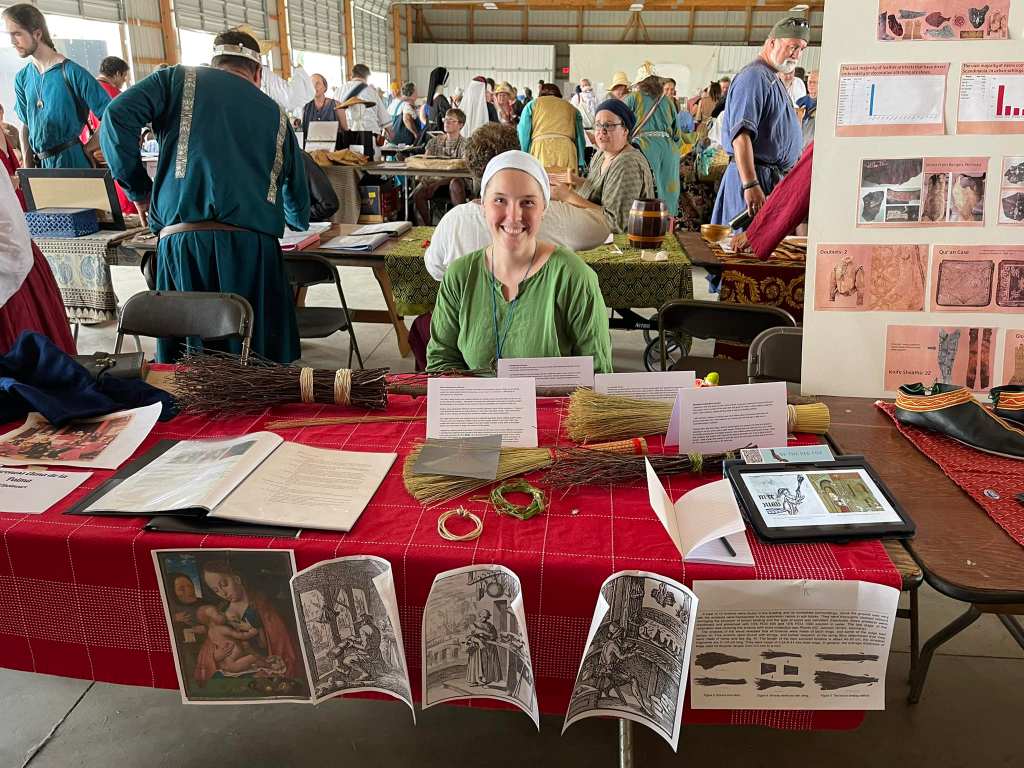
By Pennsic 50 display
Sources:
https://www.merriam-webster.com/dictionary/broom
https://robertpiwko.co.uk/besom-broom-uk/
http://www.homcraefts.com/home/brooms
Eclectic Magazine of Foreign Literature, Third Series, Vol 8
https://www.worldwidewords.org/weirdwords/ww-bro4.htm
https://electricscotland.com/gardening/heather11.htm
http://www.sussexhistory.co.uk/sussex-dialect/sussex-dialect%20-%200122.htm
https://thehighwindowpress.com/2016/09/01/peter-sirr-under-the-sway-of-the-troubadours/
https://mainlynorfolk.info/folk/songs/thebesommaker.html
https://archive.org/details/isbn_2900801474742/page/264/mode/2up?q=The+Good+Wife%5C%27s+Guide+Le+M%C3%A9nagier+de+Paris+A+Medieval+Household+Book
https://enchantedlivingmagazine.com/brooms-and-besoms-history-and-lore/
https://hyperallergic.com/332222/first-known-depiction-witch-broomstick/
https://www.gutenberg.org/files/57457/57457-h/57457-h.htm
https://books.google.com.fj/books?id=9efVPAAACAAJ&printsec=copyright#v=onepage&q=broom&f=false
https://www.academia.edu/15497252/The_story_of_medieval_brooms

 of the Red Fox